
TLDR;
Semla is the singular name, whereas semlor is plural.
A semla is a beloved and traditional Swedish baked good. It's a cardomom-spiced sweet wheat bun filled with an almond paste and whipped cream.
Historically it was eaten on Shrove Tuesday and during lent, but now it is a culturally essential part of the cullarinary calender in Sweden from January to Easter.
Where did it all begin?
Staple bread and lent goes back to, well, bibical times. The journey from a cross-shaped wheat bun to a bakery treat is long, complicated, and disputed.
The name semla comes from the latin word simila, which means fine wheat flour and ended up in Swedish via the Medieval German word semmel.
When it comes to something that would be recognisable as a semlor, and also meet the criteria to be reviewed on this website, it doesn't appear until much later, perhaps towards the end of the 1800s.
The classic modern semla with whipped cream and almond paste doesn't get a proper foothold until the 1930s.
When did semlor become popular?
What we recognise as a semla today dates to the 1930s, but it wasn't until the 1950s when semlor became really popular efter war-rationing of flour, sugar and cream ended.
From that initial take-off in the 50s, the semlor's rise has been unstoppable. Back in 2020, it was estimated that Swedes bought a whopping 40 million semlor.
Today, in the mid 2020s, it's said that Swedes now buy as many as 50 million semlor each year and bake another 30 million at home. For a population of 10.6 million, that's a lot of semlor!
What exactly makes a semla a semla?
Today there are a huge number of baked good sold as semla variants - everything from a saffron semla to a chocolate semla. Some of the variations bear little connection to a semla other than it's a filled bun.
So for the purposes of this website, a semla has to consist of four things.
- A sweet bread roll
- Almond paste
- Whipped cream
- Cardamom
If any of those first three things are missing, then it won't be reviewed as a semla. If the cardamom is missing, it will get a low rating! All this, of course, doesn't neccessarily stop them from being delious bakery items!
When can you buy semlor?
Purists will say that you shouldn't eat a semla until Shrove Tuesday. I'm not a purist when it comes to timing, but I will admit that it was quite perculiar when I treated some friends visiting from the US to semlor in June!
Back in the early 1950s, the price of semlor, and the period they could be sold, was governed by the Swedish Board of Agriculture. Thankfully, they dropped the restrictions around 1952.
Semlor are generally available in Swedish supermarkets and bakeries from the beginning of January until some point during March.
They might make an appearence in December, if there's any room amongst the saffron buns and lussekatter. Exactly when a bakery starts serving semlor varies a lot, but by mid January most will have started.
The end date for the season is much more of a sliding scale, some places might stop only a few weeks after Shrove Tuesday. As a rule, the closer you get to Easter the less likely it will be to find them.
Looking back at all of the reviews on this website, there's never been a semla reviewed in April, with March 18th being the latest date of a review. The earliest review was dated January 8th.
Recipe for semlor
If you want to have a try at making your own semlor, here's a version of the recipe I use. It makes 14 medium-sized semlor, so you might want to half this receipe unless you're really hungry!
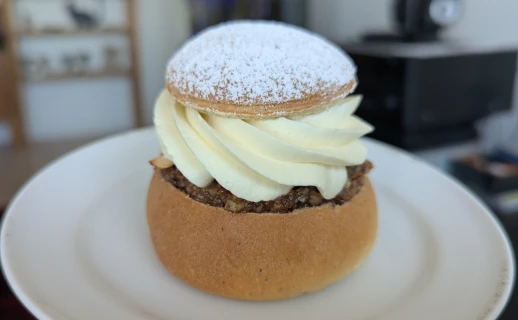
The receipe for the buns is based on the one by Swedish pastry chef Roy Fares, but with a few tweaks. The almond paste receipe here is a classic, or basic one.
The paste is where you can experiment to find something that works for you. The paste is what gives a semla its personality. Try different sugars. Try treating the amlonds in different ways. Try different proprtions. As long as it involves almonds, have a play!
Ingredients
Almond paste
- 200g blanched almonds
- 180g icing sugar
- 2 bitter almonds
- 1 egg white
Starter dough
- 200ml milk
- 260g bread flour
- 25g fresh yeast (or 2tsp dry yeast)
Final dough
- 160g bread flour
- 1 egg
- 0.5 teaspoons of salt
- 1 heaped tablespoon freshly ground cardamom
- 100g butter at room temperature
- 85g sugar
Wipped cream
- 500ml whipping cream (40%), fridge cold
- 150g mascarpone, fridge cold
Method
Almond paste
- Blanch the almonds by placing in boiling water a minute then taking the skins off.
- Put in a blender and mix until its a fine powder.
- Add the icing sugar and the egg white and mix until it's a smooth paste.
Starter dough
- Warm up the milk to 38c.
- Add to the yeast and stir until disolved.
- Mix the warm yeast and milk with the flour and run in a mixer at medium low until the dough comes together.
- Leave it to rest for 15 minutes.
Final dough
- Mix all the final dough ingredients (flour, egg, salt, cardamom, butter, sugar) in with the starter dough and mix on low speed for a few minutes then increase the speed slightly and mix for around 7 minutes until the dough is shiny and elastic.
- Divide the dough into 60g portions and roll them into ball with a cupped hand moving in circular motions.
- Place on a baking tray lined with baking paper. Make sure they are nicely spaced. Space is needed so they can rise and be baked without touching.
- Cover and leave to rise to about double the size, which should take 1.5-2 hours.
- Bake in the middle of the oven at 210c for 8-10 minutes, until they are a nice even golden brown colour. Turn them half way through to help get an even bake. Be watchful at the end as they brown really quickly.
Whipped cream
- Whip the cream and the mascarpone on a relatively low speed until the cream is just thick enough to hold its shape. Whipping slowly, and using mascapone, helps make a whipped cream that will be stable and hold its shape when piped.
- Put the whipped mascapone and cream back in the fridge until needed for construction.
Construction
- Cut off the lid from the bun. You can do this with a knife (for a circular hole), or with scissors (for a triangular hole).
- Cut the lid into a triangle, or use a round cutter to make it neatly circular.
- Put about 50g of almond paste into the well of the bun.
- Optional: place a few roughly chopped roasted/salted/caramalised nuts on top of the paste.
- Place the whipped cream into a piping bag with a closed star tip.
- Pipe a good sized swirl of cream onto the bun. It should be about 50g of cream.
- Dust the lid with icing sugar and place on top.